
Free live lecture and Zoom webinar with Bryant Baker
Co-sponsored by the Solvang Library
View the webinar recording, below.
In April of 1987 when the last of the remaining wild condors was captured, the world’s population of this iconic species totaled 27 birds. Now, due to the efforts of conservation organizations such as the California Condor Recovery Program, there are over 500 California condors with 350 of them living in the wild in California, Arizona, Utah, and Mexico. Magnificent in flight, condors have a wingspan of up to ten feet, the largest of any avian species on the continent, and can fly over 200 miles in a single day. Not surprisingly, the condor’s history and that of the region’s early as well as current human inhabitants are intertwined.
Our central coast region, and especially Los Padres National Forest, has played an out-sized role in the California
condor’s natural history and its ongoing recovery. In his presentation, Bryant Baker will explore some of the fascinating and lesser-known history of condors in our region, how their current local populations are faring, and what the future holds for the species. He will also share unique maps he has created showing condor movements across the landscape.
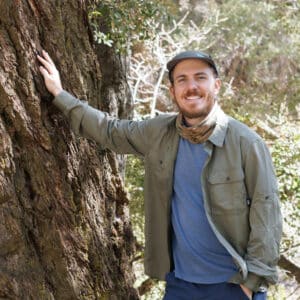
Bryant Baker is the Director of Advocacy and Education at Runners for Public Lands. He previously spent nearly a decade as the Director of Conservation and Research at Los Padres ForestWatch, where he worked to protect land and species, including the California condor. He is a published scientist, Geographic Information System (GIS) analyst, and cartographer. His maps and analyses have been featured in the Los Angeles Times, San Diego Tribune, and other media outlets. In addition to his conservation work and research, Bryant is a plant and landscape photographer whose photos have appeared in books, magazines, and newspapers across the region.
A Note About Andean Condors
During the Q&A after the lecture, a guest asked about Andean condors. Bryant provided this excerpt from an email from Louis Andaloro, who was a principal participant in the condor program:
“The Andean Condors were released into the recent historic Condor ranges, while all of the wild Condors were in captivity, to see what we & they would learn from it. That program was led by Dr. Mike Wallace, from the San Diego Zoo. I believe that all the Andean Condors were brought in before the [California] ones were released. They were essentially guinea pigs, and I think that their behavior was a bit different than their Cali Cousins, but it gave the researchers and managers good practice on the capturing, handling, transporting & processing big vultures!”
View the Zoom Recording
Event date: Thursday, February 19, 2026, 7:00 to 9:00 p.m.
Live lecture location: Solvang Library: The courtroom adjacent, 1745 Mission Drive (CA Hwy 246)
Zoom: View the webinar recording here: The Once and Future King of the Skies. Note! Please raise the recording volume for the first 15 minutes.
A question-and-answer period and light refreshments followed the lecture.